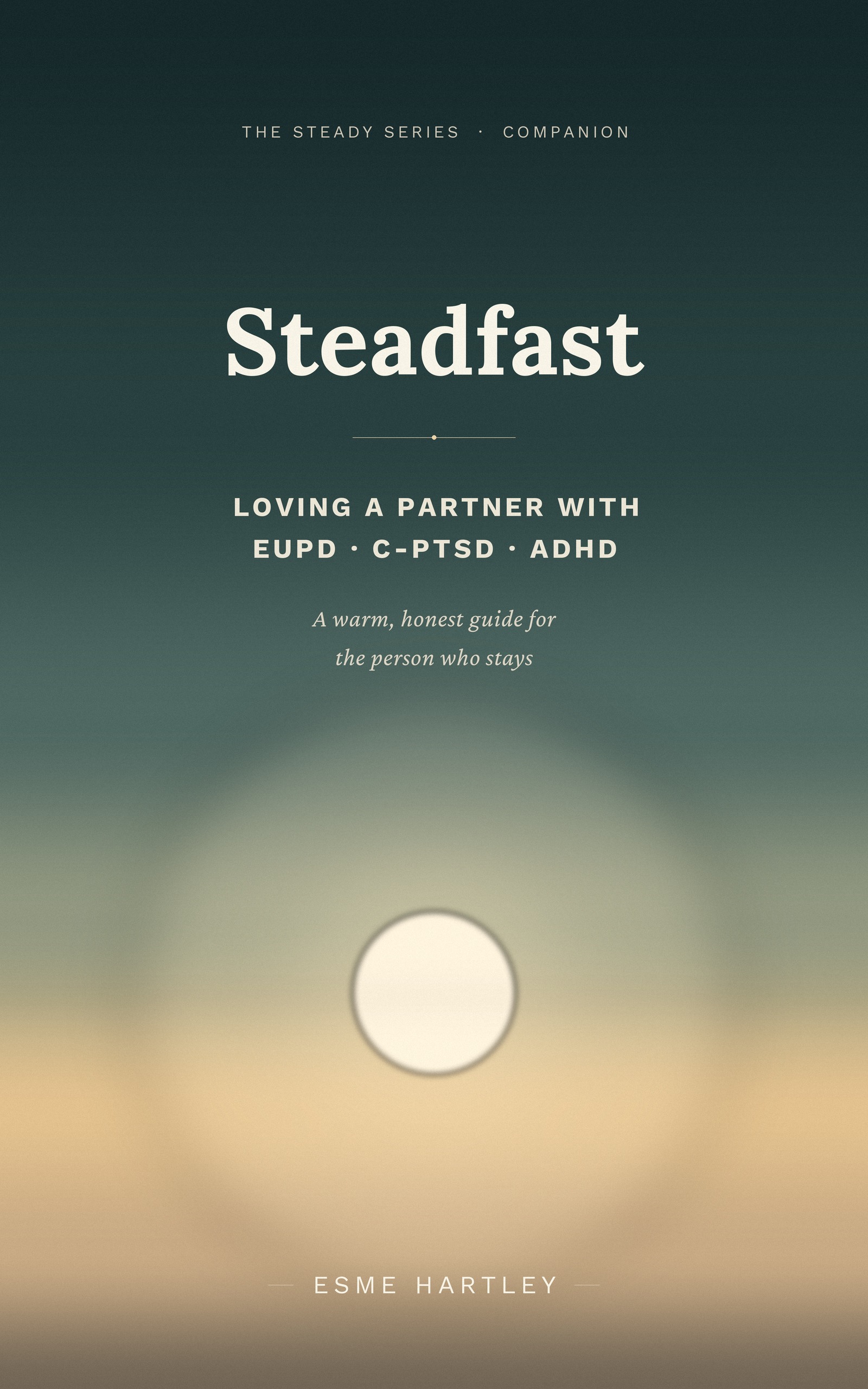
Steadfast
Loving and Supporting a Partner with EUPD, Complex PTSD, or ADHD
For the person who stays. Loving someone who carries something heavy is one of the most generous, and hardest, things a person can do. And almost no one sees how much it costs you.
If your partner storms, pushes you away, forgets, floods, or shuts down, and you love them, and you're tired, and no one around you really understands, this book is for you.
Written from a rare vantage point, by someone who lives with these conditions, translating for the partner what's really going on underneath, Steadfast explains why so much of what hurts isn't really about you, and hands you a real toolkit: be steady, validate without fixing, don't take the bait, hold kind boundaries, and look after yourself.
Compassion and boundaries. Understanding and self-care. You can love them well, and you matter too. This book shows you how, including the firm line between a hard relationship and an unsafe one.
Available now in Kindle eBook and paperback on Amazon UK and Amazon US. Part of The Steady Series by Esme Hartley.
A real toolkit, not platitudes.
Steadfast names the hard parts honestly, then walks you through the practical skills that actually help, written by someone who has used every one of them.
- Be steady, the single most powerful thing you can offer
- Validate without fixing; don't take the bait when the storm comes
- Hold kind, firm boundaries, without guilt
- Look after yourself, because you matter too
- Know the line between a hard relationship and an unsafe one
Chapter 1, The Person You Love, on a Hard Day
The first pages of Steadfast. Read it, and see if the voice is one you trust.
Let me tell you about a Tuesday evening, from two sides, because I've lived both, and understanding both is the whole beginning of this book.
From my partner's side, here is what he saw. He came home from work, tired, looking forward to a quiet evening. He said something perfectly ordinary, something about dinner, and I turned on him. Cold, then sharp, then furious, over nothing he could identify. He tried to ask what was wrong; I said "nothing," in a voice that clearly meant the opposite. He tried to fix it; that made it worse. He tried giving me space; I accused him of not caring. Within twenty minutes the evening was in ruins, he had no idea what he'd done, and he was standing in the kitchen wondering, not for the first time, whether he could keep doing this, whether the woman he loved was somewhere underneath all this or whether this was just who I was.
From my side, here is what was happening. Earlier that day something had brushed against an old wound. By the time he got home I was already underwater, flooded with a nameless dread and shame I couldn't explain and was too ashamed to admit. When he spoke, his ordinary comment landed on me like a blow, because everything was landing like a blow. The coldness was me trying to hold myself together. The sharpness was the panic spilling out. And underneath all of it was a terror I couldn't have named then but can now: he's going to see how much is wrong with me, and he's going to leave. I wasn't pushing him away because I didn't love him. I was pushing him away because I loved him and was certain I was about to lose him.
Two completely different evenings, in the same kitchen. His was bewildering and lonely and unfair. Mine was a private catastrophe I couldn't show him. And the tragedy, the thing this whole book is here to fix, is that we were both, in that moment, completely alone in it, when we could have been in it together.
The story continues in Steadfast.
A note on care. Steadfast is written from lived experience and is not a substitute for professional assessment or treatment. It includes UK and international support resources throughout. If you are struggling, you deserve real support, please see the Resources page, where help is gathered in one place.
Steadfast, frequently asked
How do you support a partner with BPD without losing yourself?
By pairing compassion with boundaries: be steady, validate without trying to fix, don't take the bait in a storm, and protect your own wellbeing. Steadfast shows you how to do all four, because you can love them well and still matter.
Is it exhausting loving someone with BPD, Complex PTSD, or ADHD?
It can be, and almost no one acknowledges that cost to you. This book is written for the supporter, naming the exhaustion honestly and giving you practical ways to stay steady without burning out.
What's the difference between a hard relationship and an abusive one?
A hard relationship has storms and repair; an abusive one has fear, control, and no safety. A condition never excuses abuse. Steadfast includes a clear chapter on that line, with domestic-abuse helplines.
Can a relationship with someone who has BPD actually work?
Yes, many do, especially when both people understand what's underneath the behaviour and the person with the condition is working on it. Understanding, boundaries, and self-care are what make it sustainable.